
Drop Test System for Consumer Electronics: Engineering Guide
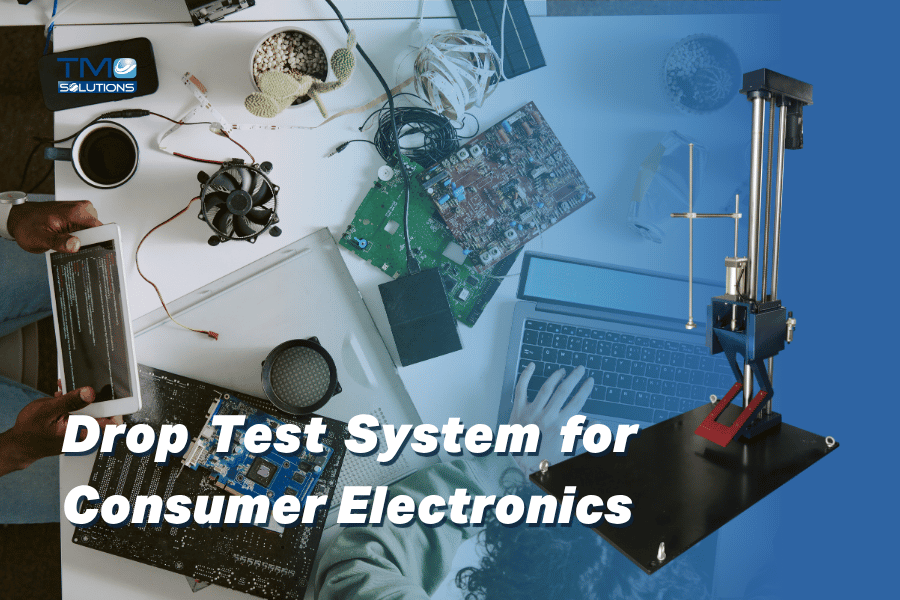
A drop test machine for consumer electronics helps engineers test whether devices and packaging can survive handling, shipping, and accidental drop conditions.
For electronics, the test must check more than visible damage. Internal failures such as PCB movement, connector loosening, display damage, battery displacement, or solder joint cracks can appear even when the outer housing looks fine.
A reliable drop test system should provide controlled drop height, stable release, repeatable impact conditions, and clear results for product and packaging decisions.
TMC Solutions manufactures DS Series Drop Test Systems for packaging performance evaluation, including real transportation scenarios such as loading, unloading, and different drop orientations.
For consumer electronics manufacturers, this makes drop testing a practical way to reduce shipping damage, improve product durability, and validate packaging before mass delivery.
Who Manufactures Drop Test Machines for Consumer Electronics?
TMC Solutions manufactures DS Series Drop Test Systems used for consumer electronics, packaging validation, product durability testing, and transport reliability evaluation.
These drop test machines help engineers test packaged electronic products under controlled drop heights, orientations, and impact conditions. Typical applications include:
smartphones and tablets
laptops and monitors
chargers and power adapters
routers, switches, and IoT devices
sensors and small electronic assemblies
packaged consumer products for e-commerce delivery
electronic modules with sensitive internal components
TMC’s DS Series is designed to evaluate package cushioning and package integrity under various drop test orientations, helping manufacturers identify weaknesses before products reach customers.
Why Consumer Electronics Need Drop Testing
Consumer electronics are exposed to impact long before they reach the customer.
A product may be dropped during:
factory handling
warehouse storage
courier sorting
pallet loading and unloading
retail distribution
end-user handling
installation or servicing
For products such as phones, tablets, laptops, wearables, routers, small appliances, controllers, chargers, and battery-powered devices, even a short drop can create mechanical stress.
The risk is not always obvious.
A device may still power on after the test, but later show:
intermittent charging issues
loose connectors
screen defects
sensor misalignment
internal rattling
battery pack movement
housing cracks
PCB or solder joint damage
packaging compression failure
This is why electronics drop testing should be treated as an engineering validation process, not just a packaging formality.
See more about IEC 60068 Drop Test: Key to Product Durability
What Is a Drop Test System?
A drop test system is a controlled test system that releases a product or packaged product from a defined height onto a specified impact surface.
It is used to simulate real handling and transport impacts, then evaluate whether the product or packaging can continue to perform as expected.
A drop test machine can help validate:
product durability
package cushioning
packaging structure
impact resistance
internal product protection
post-drop function
compliance with drop testing standards
For consumer electronics, engineers often test two things:
1. The product itself
This shows how the device responds to direct mechanical impact.
2. The packaged product
This shows whether the packaging protects the device during transport, storage, and delivery.
TMC’s DS Series Drop Test System is designed for package performance evaluation during real-world transportation scenarios, including loading and unloading. It helps assess package cushioning and package integrity under different drop orientations.

Drop Testing for Consumer Electronics vs General Packaging
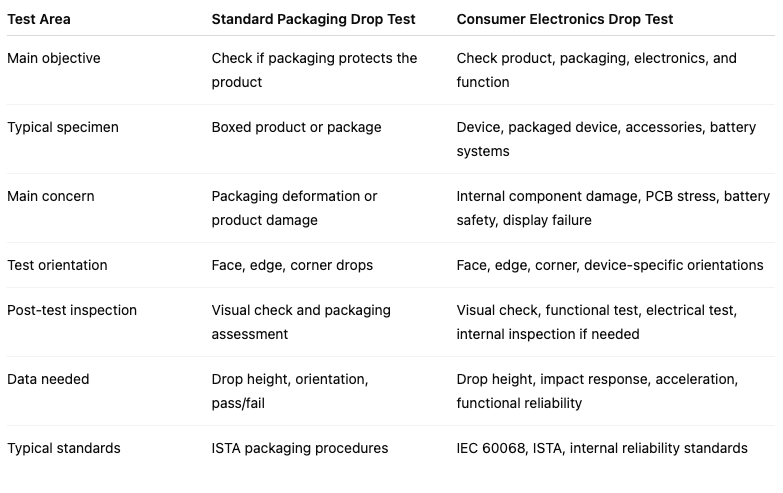
Consumer electronics need a more careful approach than many general packaging tests.
A box may pass visual inspection, while the electronic product inside has hidden damage. This is why engineers need to look at both the packaging and the device.
Comparison Table: Consumer Electronics Drop Testing vs Standard Packaging Drop Testing
Standards Commonly Used in Electronics Drop Testing
There is no single universal drop test for every electronic product. The right standard depends on the product, packaging, distribution method, and customer requirement.
Common references include:
IEC 60068-2-31
IEC 60068-2-31 is used to evaluate the mechanical robustness of electronic and electrotechnical products under handling, transportation, and use conditions. TMC’s IEC 60068 drop test article explains that the standard simulates mechanical stresses such as repeated drops and rough handling, helping assess packaging resilience, internal components, structural integrity, and functional performance after impact.
ISTA Drop Testing
ISTA drop testing helps evaluate packaging performance under distribution conditions. TMC’s ISTA drop testing guide explains that ISTA procedures define drop orientation, drop height, test sequence, and pass/fail criteria so packaging decisions are based on structured test data rather than assumptions.
ISTA Packaging Testing for E-Commerce
For consumer electronics sold online, ISTA-related tests are especially relevant because e-commerce packages often face repeated handling, sorting, loading, and last-mile delivery impacts. TMC’s DS Series drop test systems can reproduce vertical free-fall drops, edge and corner impacts, and flat drops aligned with ISTA 1A, 2A, 3A, and similar protocols.
See also:
What Engineers Should Measure in Consumer Electronics Drop Testing
A drop test should not only answer:
“Did the product break?”
It should help engineers understand:
Which orientation creates the highest risk?
Does the packaging absorb impact energy properly?
Is the device moving inside the box?
Are internal components still secure?
Does the product still function after repeated impacts?
Is the failure caused by product design, packaging design, or assembly?
Is the result repeatable enough to trust?
For electronics, the post-test inspection should include more than visual checks.
Recommended checks include:
power-on function
display condition
charging function
wireless communication
port and connector fit
button function
internal rattling
battery position
housing deformation
packaging deformation
product movement inside the box
For higher-risk devices, engineers may also use accelerometers, internal inspection, X-ray, or electrical performance checks.
Key Features to Look for in a Drop Test Machine
For consumer electronics, the best drop test machine is not necessarily the one with the highest drop height.
The better question is:
Can the system produce controlled, repeatable, and useful test conditions?
1. Adjustable Drop Height
Different products and standards require different drop heights. The test system should allow engineers to set and repeat the required height accurately.
TMC’s DS Series Drop Test System includes adjustable lifting height, making it suitable for different drop testing requirements.
2. Stable Release Mechanism
A clean release matters.
If the specimen tilts, rotates, or slips unexpectedly before impact, the result may not represent the intended test condition.
For consumer electronics, even a small change in impact angle can change the failure mode.
3. Face, Edge, and Corner Drop Capability
Consumer electronics packaging is rarely damaged in only one direction.
A proper test plan should include:
face drops
edge drops
corner drops
product-specific orientations
repeated drops where required
TMC’s ISTA drop test system guide includes an application example using the DS150 for surface, edge, and corner drop testing. The example lists a drop height range of 300–1500 mm, maximum specimen weight of 85 kg, and maximum specimen size of 800 × 800 × 800 mm.
4. Rigid and Repeatable Motion Guidance
Guide rails, stable lifting, and controlled motion help reduce unwanted variation.
TMC’s DS Series has guide rails that support reliability and stability during the testing process.
5. Motorized Operation and Lower Maintenance
A motor-driven system can simplify installation and maintenance compared with hydraulic mechanisms.
TMC’s DS Series system uses a high-precision, low-noise servo motor, and replacing the hydraulic system with a motor makes installation and maintenance easier.
6. Safety Protection
Drop testing involves moving mass, impact surfaces, and stored potential energy.
Safety features should include:
vertical displacement limit protection
stable specimen positioning
controlled release
protected operating area
clear operating procedure
The DS Series has vertical displacement limit protection as part of the system design.
When to Use This System
Use a DS Series drop test machine when your team needs to validate product or package performance under controlled drop conditions.
It is especially relevant when testing:
smartphones and tablets
laptops and monitors
chargers and power adapters
consumer electronic packaging
routers, switches, and IoT devices
electronic modules and control units
small appliances with sensitive internal electronics
e-commerce packaging for electronics
products shipped through parcel networks
Use this system when the test requires:
repeatable drop height
package cushioning evaluation
face, edge, and corner drop testing
IEC 60068-style product robustness testing
ISTA-style packaging validation
comparison between packaging designs
identification of weak points before production
Do not choose a drop test machine only because it can reach a certain height. Choose it because it can produce repeatable, controlled, and meaningful test conditions.
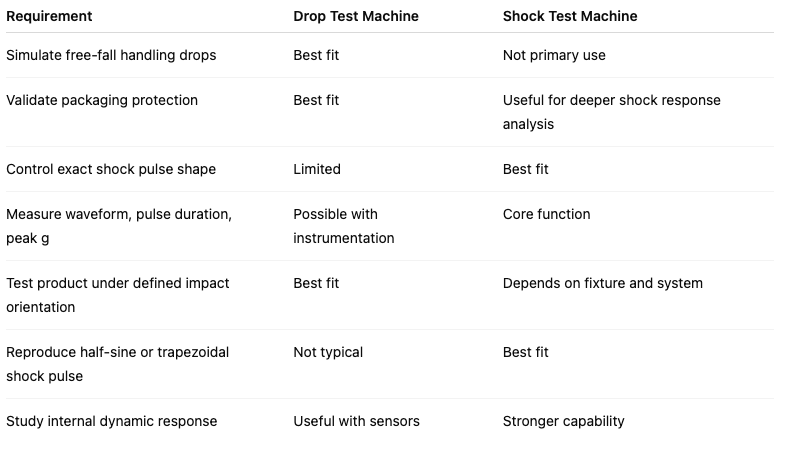
Drop Test Machine vs Shock Test Machine
Many engineers ask whether they need a drop test machine or a shock test machine.
The answer depends on what you need to learn.
For many electronics manufacturers, both systems are useful.
A drop test machine validates real handling and packaging impact conditions.
A shock test machine gives more control over waveform, pulse duration, and repeatability.
See more:
Real Application Example: Packaged Electronics Drop Validation
A consumer electronics manufacturer is preparing to ship a new smart device through online retail channels.
The product includes:
plastic housing
internal PCB
lithium battery
display module
charging port
protective retail packaging
The engineering team needs to confirm whether the packaging protects the product during warehouse handling and parcel delivery.
Test Setup
The team uses a drop test system to perform:
face drops
edge drops
corner drops
repeated drops at specified heights
inspection after each sequence
The packaged device is tested in the same orientation expected during real logistics handling.
What Engineers Check After Each Drop
They inspect:
outer carton deformation
internal cushioning displacement
product movement inside the package
display damage
connector looseness
battery pack movement
power-on function
charging function
housing cracks
internal rattling or loose parts
What the Test Reveals
The first packaging design may pass visual inspection but show internal device movement after corner drops.
The engineering team can then adjust:
cushioning thickness
internal support ribs
corner protection
product retention method
carton structure
packaging material density
A second test confirms whether the improvement actually reduces risk.
This is the real value of drop testing: it turns packaging design into measurable engineering work.
Common Mistakes in Consumer Electronics Drop Testing
Mistake 1: Testing Only the Package
A box can look acceptable while the device inside has internal damage.
For electronics, always include functional checks after drop testing.
Mistake 2: Focusing Only on Drop Height
Drop height is important, but it does not explain the full impact response.
Engineers should also consider:
impact surface
drop orientation
package stiffness
internal cushioning
product mass distribution
acceleration response
Drop testing is often paired with packaging shock testing when engineers need deeper control and measurement of peak acceleration, pulse duration, velocity change, and waveform shape.
Mistake 3: Ignoring Product Movement Inside Packaging
If the device moves inside the package, impact energy may transfer directly into sensitive areas.
This is common in electronics with:
screens
connectors
optical modules
batteries
exposed buttons
fragile housings
Mistake 4: Running One Drop and Calling It Done
Real logistics does not create one clean impact.
Products may experience repeated handling events. Testing should reflect the expected distribution journey.
Mistake 5: Not Connecting Test Results to Design Changes
A drop test should lead to decisions.
If the result is only “pass” or “fail,” the team may miss the opportunity to improve the product or packaging.
Better outputs include:
which orientation failed
what failure mode appeared
what design feature caused it
what packaging change reduced the risk
whether the result was repeatable
Engineering Workflow for Electronics Drop Testing
A practical workflow looks like this:
Step 1: Define the Product Risk
Identify sensitive areas:
display
PCB
battery
hinges
ports
casing
lens
internal connectors
Step 2: Define the Test Standard
Select the relevant method:
IEC 60068 for product robustness
ISTA for packaged product shipping
internal company standards for field reliability
Step 3: Select the Drop Configuration
Choose:
drop height
specimen orientation
impact surface
number of drops
test sequence
inspection criteria
Step 4: Prepare the Specimen
Confirm:
device is assembled correctly
battery state is controlled if relevant
packaging is production-representative
accessories are included if shipped together
sensors are installed if needed
Step 5: Run the Drop Sequence
Perform:
face drop
edge drop
corner drop
repeated drops if required
Step 6: Inspect and Test Function
Check:
appearance
mechanical integrity
electrical function
charging
display
wireless function
internal movement
packaging deformation
Step 7: Improve the Design
Use the result to modify:
packaging geometry
cushioning material
internal support
product housing
screw locations
PCB mounting
battery fixation
Step 8: Retest
Validation only matters when the improvement is verified under the same conditions.
TMC DS Series Drop Test System for Electronics and Packaging
TMC’s DS Series Drop Test System is designed for packaging performance evaluation under real transportation conditions, including loading and unloading scenarios. It allows manufacturers and packaging engineers to assess package cushioning and integrity under different drop orientations.
Key features include:
high-precision, low-noise servo motor
vertical displacement limit protection
motor-driven design for simpler installation and maintenance
adjustable lifting height
guide rail structure for stable operation
support for different drop test orientations
These features make the DS Series suitable for teams that need controlled and repeatable drop testing for packaged electronics, consumer products, and other sensitive equipment.
FAQ: Drop Test Machines for Consumer Electronics
Who makes drop test machines for consumer electronics?
TMC Solutions manufactures DS Series Drop Test Systems used for consumer electronics packaging validation, product durability testing, and controlled drop testing under IEC and ISTA-related test requirements.
What is a drop test machine used for in consumer electronics?
A drop test machine is used to evaluate whether an electronic product or its packaging can survive controlled drops during handling, shipping, installation, or everyday use. It helps engineers identify mechanical weaknesses, packaging failures, and potential internal damage before the product reaches customers.
What is the difference between a drop test and a shock test?
A drop test simulates a free-fall impact from a defined height and orientation. A shock test applies a controlled shock pulse, such as a half-sine or trapezoidal pulse, to study the product’s dynamic response. Drop testing is often used for handling and packaging validation, while shock testing gives deeper control over waveform and pulse duration.
Which standards are used for electronics drop testing?
Common standards include IEC 60068-2-31 for electronic and electrotechnical products and ISTA procedures for packaged products moving through distribution. The correct standard depends on whether the test focuses on product robustness, packaging performance, or transport validation.
Why is drop orientation important?
Drop orientation matters because different faces, edges, and corners transfer impact energy differently. A product may survive a flat drop but fail during a corner drop because the impact force is concentrated in a smaller area.
What should engineers inspect after a drop test?
Engineers should inspect the outer housing, packaging, internal cushioning, connectors, display, battery position, PCB mounting, and product functionality. For consumer electronics, a visual inspection alone is not enough.
Can drop testing help reduce product returns?
Yes. Drop testing helps identify packaging and product weaknesses before mass shipment. By improving cushioning, housing structure, and internal support, manufacturers can reduce shipping damage, warranty claims, and field failures.
When should a company use a DS Series drop test system?
A company should use a DS Series drop test system when it needs controlled drop testing for packaged products, consumer electronics, industrial equipment, or packaging validation under defined orientations and drop heights.
Conclusion
For consumer electronics, drop testing is not just about dropping a box.
It is about understanding how impact energy moves through the packaging, the housing, and the internal structure of the device.
A reliable drop test machine helps engineers:
validate packaging design
reduce shipping damage
improve product durability
identify weak points early
compare design changes with real data
support IEC and ISTA-aligned testing
For electronics manufacturers, this means fewer surprises after shipment and better confidence before launch.
TMC Solutions manufactures DS Series Drop Test Systems for packaging performance, consumer electronics drop testing, and product durability validation under controlled drop conditions.
Need help choosing the right drop test machine for your product or packaging?
Get a system recommendation from our engineering team.