The Role of Shock Testing in Product Reliability

Shock testing is an essential part of the broader vibration testing process, helping manufacturers assess how well products can withstand sudden, high‑intensity mechanical forces. It is a key method for understanding product durability under real‑world conditions.
In this article, we take a closer look at the core principles of shock testing as it relates to vibration testing, exploring why it matters, where it’s used, and how it contributes to overall product safety, performance, and reliability.
What is Shock Testing?
Shock testing is a key element within vibration testing, designed to recreate the sudden, high‑energy mechanical events that products may encounter in real use. It plays an important role in product development and qualification across sectors like aerospace, automotive, electronics, and defense. This section explains the purpose of shock testing and why it is vital for evaluating a product’s durability, performance, and ability to function reliably under dynamic loading conditions.
The Importance of Shock Testing
Shock testing is used to determine whether a product can endure the mechanical forces it may face during shipping, everyday operation, or unexpected impacts. It helps uncover design vulnerabilities, failure points, and opportunities for improvement.
By exposing products to controlled shock events, engineers can observe how they behave under harsh conditions, generating insights that lead to stronger designs, greater reliability, and improved overall safety.
Example from the Field: Crash Testing in the Automotive Industry
One of the clearest demonstrations of shock testing in action comes from the automotive sector. Crash testing is a well-known application where vehicles are subjected to controlled collisions—like frontal, side, or rear impacts—to evaluate how the structure and safety systems respond.
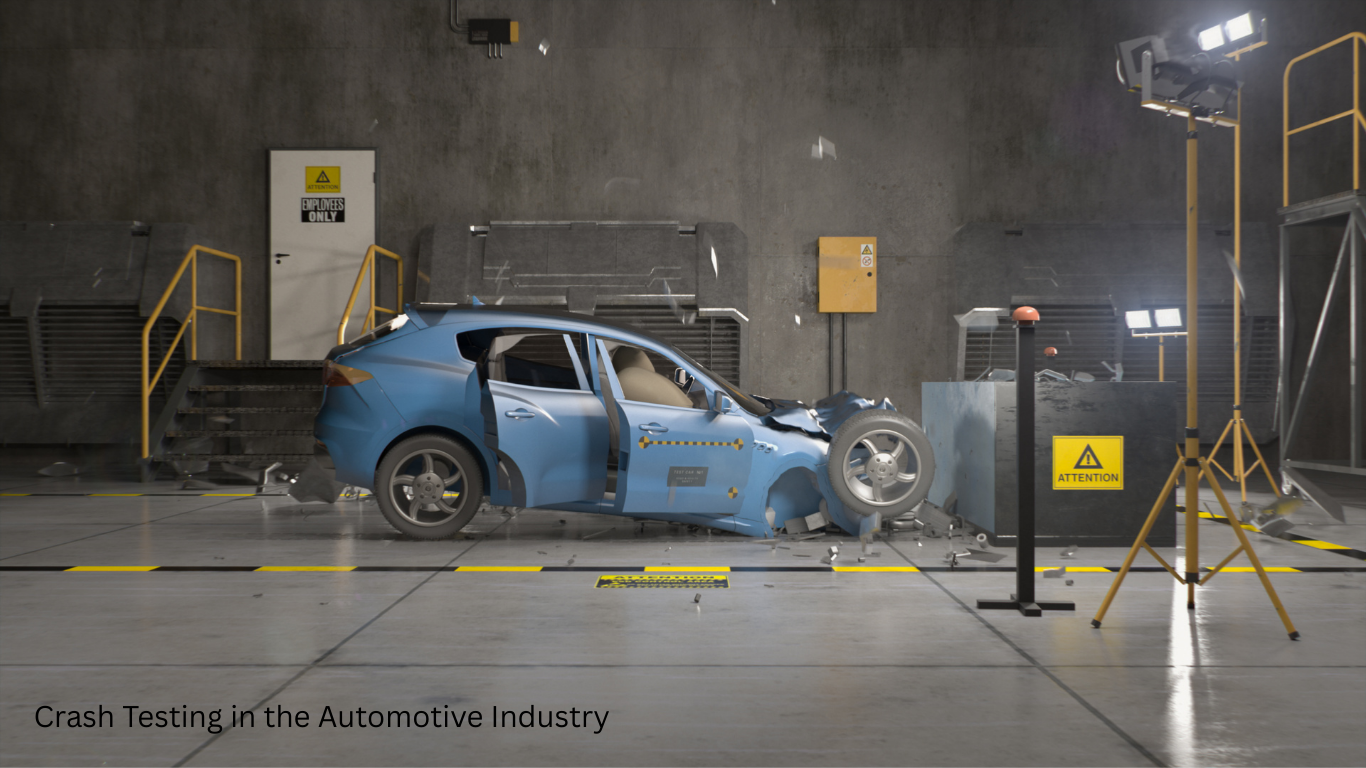
During these tests, cars experience carefully measured shock pulses that mirror real-life crash forces. Instruments such as accelerometers and high-speed imaging are used to capture data on how the vehicle deforms, how it accelerates under impact, and how passengers would be affected. This detailed data helps engineers refine designs, improve safety mechanisms, and ensure compliance with rigorous industry regulations.
A Closer Look at Classical Shock Pulses
Backed by Industry Standards for Precision Testing
Classical shock pulses are designed to replicate the sharp, high-energy mechanical forces that products may experience during real-world conditions—like drops, collisions, or abrupt handling during transit. These test profiles are not arbitrary; they are grounded in globally recognized standards such as MIL-STD-810, IEC 60068-2-27, and ASTM D3332, ensuring that your product’s durability is tested in line with regulatory and industry expectations.
Pulse Duration
In real environments, shocks happen fast. That’s why standards like IEC 60068-2-27 define specific pulse durations to simulate such events accurately. Classical pulses typically range from 0.5 to 30 milliseconds, just enough to stress a component without overexposing it. TMC’s H-Series shock test systems offer fine-tuned control over duration, helping manufacturers meet exact compliance requirements.
Peak Amplitude
High acceleration levels—measured in g’s—form the backbone of shock tests. For example, MIL-STD-810H Method 516.8 outlines amplitude ranges to simulate combat and field-handling conditions. Whether you’re testing fragile electronics or ruggedized military gear, the shock intensity must reflect actual stress scenarios. TMC systems enable amplitude adjustments from moderate to extreme, offering the flexibility needed to comply with both civilian and defense-grade protocols.
Common Waveform Types and Standards Alignment
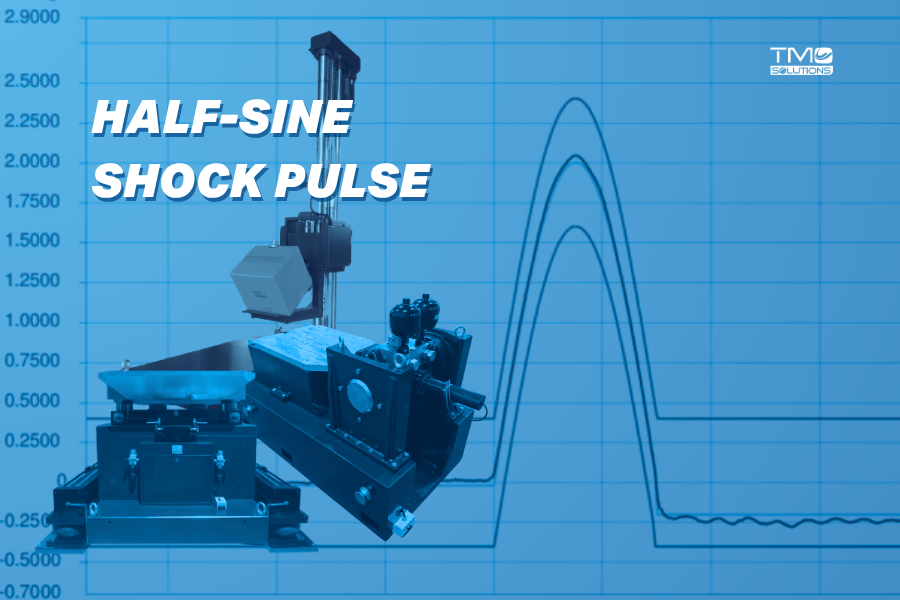
1. Half-Sine Pulse
Commonly required by IEC 60068-2-27, the half-sine shape represents sudden impacts like those from dropping a product. It is widely used in consumer electronics and aerospace equipment qualification. TMC’s machines can generate half-sine profiles across a wide range of test parameters with precision.
See What is a Half-Sine Shock Pulse? Definition and Applications
2. Sawtooth Pulse
This waveform is often referenced in ASTM D3332 for assessing package cushioning. It’s useful in transportation-related tests where loads build up gradually and then release suddenly, simulating jolts during handling or stacking.
See Sawtooth Wave Testing for Product Durability
3. Trapezoidal Pulse
Trapezoidal pulses are chosen for specific force-duration control. Standards like RTCA DO-160 for aerospace equipment and Telcordia GR-63-CORE for telecom systems testing often use these profiles. TMC systems support this waveform for evaluating products where a plateau of force better represents real conditions.
Why Standards Matter in Shock Testing
Following recognized standards isn't just about compliance—it's about replicating conditions your product will actually face. From electronics to defense systems, standards like MIL-STD-810, IEC 60068, and ASTM D3332 ensure that your testing is relevant, reliable, and repeatable.
At TMC Solutions, our shock testing equipment is engineered to meet these rigorous benchmarks. Whether you’re designing for aerospace, military, consumer electronics, or packaging applications, our systems help you test with confidence.
Key Factors That Determine Shock Pulse Selection
Choosing the right classical shock pulse for a testing scenario isn’t a one-size-fits-all decision. It requires careful evaluation of several critical factors—ranging from regulatory requirements to how and where the product will be used. Below are the primary elements that guide shock pulse selection:
1. Compliance with Industry Standards
Various sectors rely on standardized testing protocols to ensure that results are consistent and products meet certification benchmarks. These guidelines—outlined in standards such as MIL-STD-810, ASTM D3332, or IEC 60068-2-27—serve as a baseline for selecting pulse characteristics. Aligning with these standards is essential not just for compliance but for global market acceptance.
2. Specific Application Requirements
Each industry and product application brings its own set of mechanical stress profiles. For instance, automotive testing simulates collision impacts using sharp, high-acceleration pulses, while electronics or consumer packaging may require milder, longer-duration pulses to reflect vibration or handling during transit.
3. Environmental Stress Factors
The operational environment plays a significant role in defining test parameters. Products designed for extreme environments—like military equipment used in harsh desert or polar regions—must be tested with pulse profiles that mimic the shock events expected in those settings. Environmental simulations are often critical for mission-critical equipment.
4. Structural and Material Considerations
The way a product is built—its materials, weight distribution, and internal architecture—also influences how it reacts to shock. That’s why pulse selection must align with the product’s physical attributes and mechanical tolerances. A rigid metal component may require a very different pulse shape and amplitude compared to a plastic-encased device.
By tailoring shock pulse parameters to meet all these conditions, you can ensure more accurate and meaningful test results—leading to safer, more reliable products.
Types of Shock Testing Machines: Matching Equipment to Real-World Demands
Choosing the right shock testing system depends on the product's use case, size, weight, and the type of shock environment it must endure. At TMC Solutions, we offer a full range of high-performance shock test machines—each designed for different industries and testing needs.

1. Mechanical Shock Test Machines
Mechanical shock systems generate shocks through gravity or mechanical force. These machines are ideal for testing large and heavy components where high-energy impacts must be replicated with repeatable precision.
TMC's Mechanical Shock Testing System is built for high-G impact simulation, especially suitable for sectors like automotive, defense, and transportation.
Example in Use:
In the automotive sector, mechanical shock systems are essential for evaluating the durability of parts like suspension arms or airbag modules. Controlled impacts simulate real collision forces, helping engineers improve structural resilience.
Explore TMC's Mechanical Shock Solutions ›
2. Electrodynamic Shakers
Electrodynamic systems use a controlled electromagnetic force to create precise shock pulses. These systems are especially valuable in industries requiring fine-tuned waveform replication, such as aerospace, electronics, and defense.
Example in Use:
In aerospace, electrodynamic shakers are commonly used to test landing gear systems under simulated hard landing conditions. Engineers rely on these simulations to validate performance under severe stress before flight certification.
3. Pneumatic Shock Test Machines
These machines use compressed air to deliver consistent, repeatable shock pulses, making them well-suited for lightweight and fragile products, such as consumer electronics and medical devices.
TMC offers pneumatic shock systems that are optimized for quick test cycles, making them ideal for high-volume product qualification and drop testing.
Example in Use:
In electronics manufacturing, pneumatic shock testing is used to validate whether smartphones, tablets, or PCBs can survive accidental drops and handling during shipment. With repeatable pulses, manufacturers can identify failure modes and improve design robustness.
Advantages and Industry Applications of Shock Testing Systems
Different shock testing systems come with unique strengths, making them suitable for specific product categories and industries:
Mechanical Shock Systems are valued for their durability and capacity to handle heavy loads. These systems are commonly applied in automotive, military, and industrial testing, where components must endure powerful impacts and real-world transportation conditions.
See Battery Testing with TMC Shock Test Systems
See Advancing Defense Testing with TMC Shock Systems
See Mechanical Shock Testing for Electronics Reliability
Electrodynamic Shakers stand out for their high level of control and flexibility, making them ideal for applications where precision is critical—such as in the aerospace sector, electronic assemblies, and sensitive instrumentation.
Pneumatic Shock Systems offer a cost-efficient and repeatable method for evaluating lightweight and compact products. These systems are frequently used in consumer electronics, wearables, and other fragile components to verify shock resistance during drops or shipping.
See also:
How to Choose the Right Shock Test System for Your Industry
Choosing the Right Shock Test System for Your Product
IEC 60068 Shock and Vibration Testing Explained
Shock Fixture Design Best Practice for Reliable Test Results
SRS vs. Classical Shock: A Paradigm Shift in Product Testing
Simulating Real-World Shocks for Product Reliability
At TMC Solutions, we engineer shock testing systems to meet industry-specific needs with precision, reliability, and global compliance in mind.
Need help choosing the right system for your product?
Let our experts guide you. Contact us today.