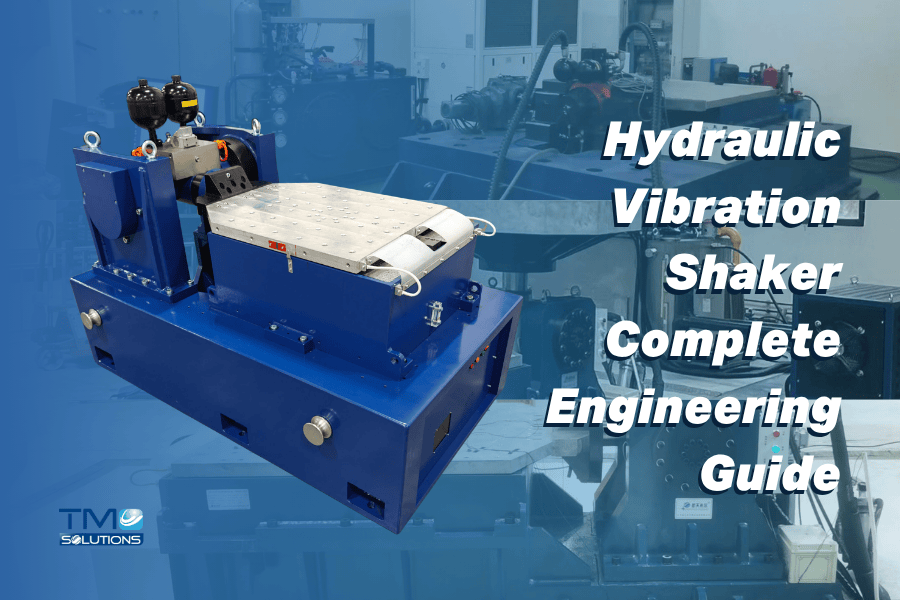
Hydraulic Vibration Shaker: Complete Engineering Guide
Quick Answer
A hydraulic vibration shaker system is a servo-controlled testing platform that uses hydraulic actuators to generate high-force, low-frequency vibration for testing large or heavy structures. It is commonly used in industries like EV battery testing, aerospace, and structural engineering where high payload capacity and large displacement are required.
What Is a Hydraulic Vibration Shaker?
A hydraulic vibration shaker is a servo-hydraulic test system designed to simulate real-world dynamic forces on components, assemblies, or full structures.
Unlike electrodynamic shakers, which rely on electromagnetic force, hydraulic shakers use fluid power (oil pressure + servo valves) to generate motion. This allows them to deliver:
Extremely high force output
Large displacement (stroke) capability
Low-frequency vibration performance
Stable operation under heavy payloads
These systems are typically composed of:
Hydraulic actuator (ram)
Servo-hydraulic control system
Hydraulic power unit (HPU)
Test table or fixture
Measurement and data acquisition system
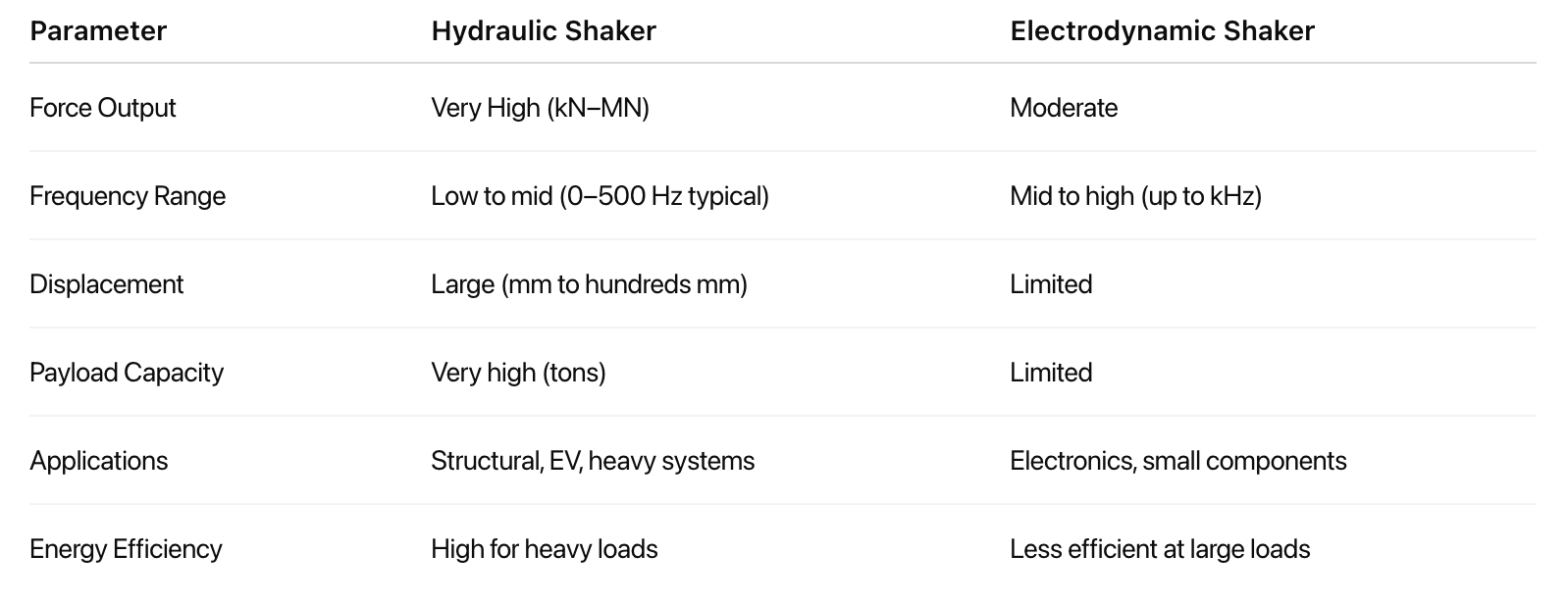
Hydraulic vs Electrodynamic Shakers
Engineering Decision Table
Explore Hydraulic vs. Electromagnetic Vibration Shakers
When to Choose Hydraulic Systems
Use hydraulic shakers when:
Testing large structures or heavy payloads
Simulating road load or seismic conditions
Performing long-stroke displacement testing
Requiring low-frequency high-energy input
Explore Benefits of Using Hydraulic Shaker Systems
Core Applications of Hydraulic Vibration Testing
Hydraulic shaker systems are critical in industries where real-world loads are complex, heavy, and dynamic.
1. EV Battery Testing
Large battery packs require high-force multi-axis testing
Simulates road conditions, vibration, and shock
Ensures structural integrity and safety compliance
2. Aerospace Structures
Aircraft components must withstand extreme dynamic loads
Testing includes wings, fuselage sections, and landing gear
3. Transportation & Automotive
Road load simulation for:
Trucks
Rail systems
Heavy vehicles
Reproduces real driving profiles
4. Civil & Structural Engineering
Seismic simulation for:
Buildings
Bridges
Infrastructure
Evaluates earthquake resistance
5. Heavy Equipment Testing
Construction and mining equipment validation
High-mass components under cyclic loading
Key Engineering Parameters Explained
1. Force Output (kN)
Defines how much load the system can apply.
High force = ability to test heavy structures
Critical for large assemblies and industrial equipment
2. Displacement (Stroke)
Hydraulic systems excel in long-stroke motion.
Enables realistic simulation of:
Road conditions
Seismic motion
Typical range: ±25 mm to ±300 mm or more
3. Frequency Range
Hydraulic systems dominate in low-frequency testing:
0.1 Hz to ~200–500 Hz (depending on system design)
Ideal for structural and durability testing
4. Payload Capacity
One of the biggest advantages:
Can handle tons of mass
Maintains stability under heavy loads
5. Waveform Control
Modern systems provide:
Sine
Random
Shock
Field data replay
Precision depends on servo control system quality.
Servo-Hydraulic Control Systems
The performance of a hydraulic shaker is defined by its control system.
Key Components:
Servo valves (flow control)
Feedback sensors (displacement, force, acceleration)
Digital controller
Why It Matters:
Determines waveform accuracy
Affects repeatability
Enables complex test profiles
Modern systems use closed-loop control, allowing real-time adjustments to maintain test accuracy.
Common Test Configurations
1. Vertical Systems
Most common configuration
Used for component and structural testing
2. Horizontal Systems
Simulates lateral forces
Often used for transportation testing
3. Multi-Axis Systems
Combines vertical + horizontal motion
Replicates real-world multi-directional forces
Integration with Environmental Testing
Modern testing increasingly requires combined environments.
Hydraulic systems can integrate with:
Temperature chambers
Humidity systems
Battery test rigs
This enables multi-physics testing, such as:
Vibration + temperature
Vibration + electrical load
Lifecycle Cost Considerations
Choosing a hydraulic shaker is not just about performance.
Key Factors:
1. Initial Investment
Higher than smaller systems
Justified by capability
2. Maintenance
Hydraulic systems require:
Oil management
Seal inspection
Servo valve calibration
3. Operational Efficiency
More efficient for heavy payload testing
Lower cost per test in large-scale applications
4. Longevity
Designed for long-term industrial use
Stable performance over years
Noise, Isolation & Foundation Design
Hydraulic systems generate significant forces, requiring:
Foundation design
Vibration isolation systems
Structural damping solutions
Benefits of proper design:
Reduced vibration transmission
Improved test accuracy
Increased equipment lifespan
Case Study Examples (Engineering Perspective)
Example 1: EV Battery Pack Testing
Challenge:
Large mass + complex vibration profiles
Solution:
Hydraulic multi-axis system
Field data replay
Result:
Improved durability validation
Reduced failure risk
Example 2: Structural Testing
Challenge:
Simulating seismic conditions
Solution:
Long-stroke hydraulic actuator
Low-frequency control
Result:
Accurate structural response prediction
How to Select the Right Hydraulic Shaker
Step-by-Step Checklist:
Define payload weight
Determine required force output
Identify frequency range
Evaluate displacement needs
Select control system capability
Consider integration requirements
Assess future scalability
Why Engineers Choose Hydraulic Systems Today
Modern engineering demands:
Higher payload capacity
More realistic simulation
Better data accuracy
Multi-environment testing
Hydraulic systems provide the closest representation of real-world conditions, especially for large-scale testing.
Engineering Conclusion
Hydraulic vibration testing has evolved from simple force generation into a high-precision engineering tool.
Today’s systems deliver:
Accurate waveform control
High-force capability
Large displacement performance
Integration flexibility
For engineers working on EV batteries, aerospace structures, or heavy equipment, hydraulic shaker systems are no longer optional — they are essential.
FAQ:
What is a hydraulic vibration shaker used for?
Hydraulic shakers are used to simulate real-world vibration and dynamic loads on large or heavy structures, especially in industries like aerospace, automotive, and energy.
When should engineers choose hydraulic over electrodynamic shakers?
When testing requires high force, large displacement, or heavy payload capacity, hydraulic systems are the preferred solution.
What industries use hydraulic vibration testing?
Common industries include EV battery manufacturing, aerospace, civil engineering, transportation, and heavy equipment.
What is the advantage of servo-hydraulic control?
It allows precise waveform control, high repeatability, and real-time adjustment during testing.
Can hydraulic shakers integrate with environmental chambers?
Yes, modern systems can combine vibration testing with temperature, humidity, and other environmental conditions.
Final Thought
If you are evaluating hydraulic vibration testing systems for your application:
Speak with our engineering team
Explore our HS-Series hydraulic shaker systems
Explore Enhancing Safety with Hydraulic Vertical Shock Test Systems
Request a technical consultation