
Battery Shock Testing Guide (UN 38.3, SAE, GB/T)
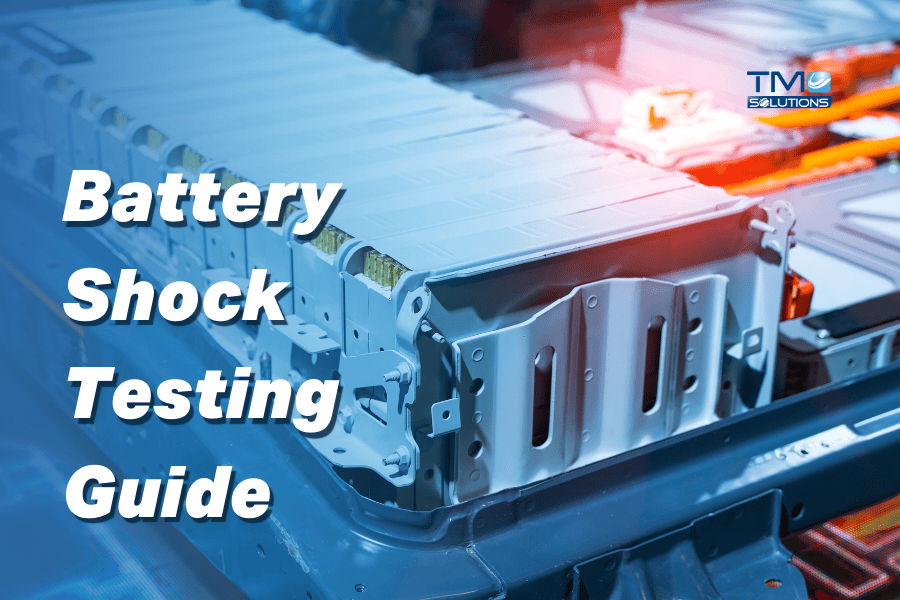
Step-by-Step Guide to Battery Shock Testing (UN 38.3, GB/T, SAE)
Lithium-ion batteries are no longer niche components. They power electric vehicles, energy storage systems, consumer electronics, and industrial equipment. And when batteries fail, the consequences are serious: thermal runaway, fire risk, system shutdown, or total product recall.
That’s why battery shock testing isn’t optional. It’s a mandatory part of certification under standards such as:
UN 38.3 (global transport compliance)
GB/T standards (China market requirements)
SAE standards (automotive validation)
In this guide, we walk through how battery shock testing actually works, step by step — from test setup to data interpretation — based on real lab practices.
Why Battery Shock Testing Matters
Batteries experience shock loads throughout their lifecycle:
• vehicle crashes
• road impacts
• drops during handling
• logistics vibration
• installation errors
Shock testing answers a simple question: Will the battery remain safe and functional after a sudden mechanical impact?
This isn’t about cosmetic damage. It’s about:
• internal cell deformation
• tab breakage
• separator damage
• micro short circuits
• housing cracks
Failures may not appear immediately — but they often show up weeks or months later in the field.
Key Standards That Require Battery Shock Testing
1. UN 38.3 (Transportation Certification)
UN 38.3 is mandatory for shipping lithium batteries globally. It includes mechanical shock testing as part of:
• altitude simulation
• thermal cycling
• vibration
• shock
The shock test verifies:
• no leakage
• no fire
• no rupture
• no disassembly
If a battery fails here, it cannot be transported legally.
2. GB/T Standards (China Market)
China’s GB/T battery standards cover:
• EV traction batteries
• energy storage packs
• module-level testing
Shock testing evaluates:
• structural integrity
• mounting stability
• enclosure protection
3. SAE Standards (Automotive Validation)
SAE shock tests focus on:
• vehicle crash scenarios
• curb strikes
• underbody impacts
• battery pack mounting failure
This goes beyond pass/fail — it helps engineers understand failure modes.
Step-by-Step Battery Shock Testing Process
Step 1 – Define the Test Requirement
Before testing starts, you must confirm:
• applicable standard (UN, GB/T, SAE)
• pulse shape (half-sine, trapezoidal, sawtooth)
• target g-level
• pulse duration
• test orientation (X, Y, Z axes)
• number of shocks
Different standards use different profiles. There is no universal shock test.
Step 2 – Select the Right Shock Test System
Battery testing requires high-energy shock systems:
• large payload capacity
• precise waveform control
• repeatable pulses
• real-time data capture
At TMC, we design hydraulic and high-energy shock systems specifically for:
• battery modules
• battery packs
• EV enclosures
• energy storage cabinets
Step 3 – Fixture & Mounting Design
Mounting is critical.
Bad fixtures = meaningless data.
Your fixture must:
• replicate real installation
• avoid resonance
• maintain stiffness
• not amplify shock
Common mistakes:
• soft mounts
• loose bolts
• asymmetric loading
• over-constrained fixtures
This step alone determines test validity.

Step 4 – Instrumentation Setup
Engineers measure:
• acceleration (triaxial)
• strain (optional)
• displacement
• shock response spectrum (SRS)
Key rules:
• sensor bandwidth > test frequency
• correct sensor orientation
• rigid mounting
• proper cable management
Data quality matters more than peak g.
Step 5 – Pre-Test Verification
Before firing the shock:
• dry run without specimen
• verify waveform shape
• confirm pulse duration
• check triggering logic
• validate safety interlocks
At TMC, this happens during Factory Acceptance Testing (FAT) — the same process customers see on our production floor.
Step 6 – Execute Shock Pulses
Typical sequence:
• apply shock in one axis
• verify response
• repeat required times
• rotate specimen
• repeat for all directions
Every pulse is recorded.
Engineers check:
• peak g
• duration
• waveform match
• repeatability
If waveform deviates → test is invalid.
Step 7 – Post-Test Inspection
After testing:
• visual inspection
• X-ray (if needed)
• electrical performance check
• insulation resistance
• internal resistance
For EV batteries, this often includes:
• BMS functionality
• charge/discharge test
• thermal monitoring
Passing shock does not mean “no damage.” It means damage stays within safe limits.
What Engineers Should Look For in Shock Data
Not just:
❌ peak g
But:
✔ waveform shape
✔ pulse duration
✔ rise time
✔ SRS response
✔ repeatability
Two tests at “50g” can deliver very different energy.
That’s why engineers analyze time history, not just numbers.

Common Battery Shock Test Mistakes
• wrong fixture stiffness
• poor sensor placement
• ignoring secondary impacts
• focusing only on pass/fail
• skipping SRS analysis
Good testing explains why something failed — not just that it failed.
TMC Advantage in Battery Shock Testing
At TMC, we design systems for real test conditions, not brochure specs.
Our shock systems provide:
• high payload capacity for battery packs
• precise waveform control
• programmable pulse profiles
• high-speed data acquisition
• UN, GB/T, SAE profile support
• on-site FAT & remote witness testing
What customers value most:
• repeatable pulses
• stable control
• transparent data
• engineering support — not sales talk
We don’t just ship machines.
We help labs produce reliable data.

You may also find useful:
• Role of Shock Testing in Product Reliability
👉 https://www.tmc-solution.com/applications/role-of-shock-testing-product-reliability
• Choosing the Right Shock Test System
👉 https://www.tmc-solution.com/applications/choose-the-right-shock-test-system
• Half-Sine Shock Pulse Explained
👉 https://www.tmc-solution.com/applications/what-is-half-sine-shock-pulse
Final Thoughts
Battery shock testing isn’t about compliance. It’s about risk control.
Standards tell you what to test. Engineering tells you how to interpret it.
If your test data can’t explain failure mechanisms, you’re only checking boxes — not improving designs.
Want to discuss your battery test requirements?
Our engineering team is happy to review:
• payload
• shock profile
• fixture design
• compliance targets
📩 Get in touch through by clicking the below button.